

What is SEO?
Search Engine Optimisation – usually referred to as SEO – is a set of strategies used to improve user experience on a website and to build trust and authority for a business across the web. These improvements then help your website appear higher in search results on sites such as Google and Bing, and to appear in AI responses.
Users that come to your website as a result of SEO are usually referred to as organic traffic. SEO strategies include content creation, link building and technical improvements.
This kind of digital marketing usually takes time – often months or even years – to have an effect. It’s ideal if you’re thinking long-term for your business. Though growth is gradual, when you start seeing results from SEO, they can be long-lasting and extremely effective.
What is PPC?

Pay Per Click – or PPC – is a way to bring paid traffic to your website. A user clicks on an advertisement you’ve created, and you pay for that click. You can use a whole range of adverts in PPC, including text-only ads, Shopping Ads, and banner ads. PPC is generally more expensive than SEO in the long-run, but results can be much faster.
Paid ads appear alongside organic (unpaid) results on search engines such as Google and Bing. Those that are best optimised and most relevant to the search query appear at the top of the organic results. Others may appear further down the page.
Paid ads listings can also be more eye-catching because they frequently use imagery and are given key placements on the page.
PPC will often boost traffic to your website in the short-term, though when you stop running ads traffic will fall back to normal levels.
Using SEO and PPC Together For More Effective Results
There is a theory in search engine marketing known as “1+1=3”. The idea behind this is that, when done individually, SEO and PPC each generate one visit to your website. However, when used together, they will generate three visits. There are even academic studies that demonstrate this happening.
With that in mind, let’s take a look at how PPC and SEO work best together.
Visibility
Imagine you are ranking well organically for a phrase, such as Lake District tipi hire. Your website is already visible on the first page of Google thanks to your SEO work. Unfortunately, there are several competitor websites showing above your organic listing because they have paid for prime space through advertising.
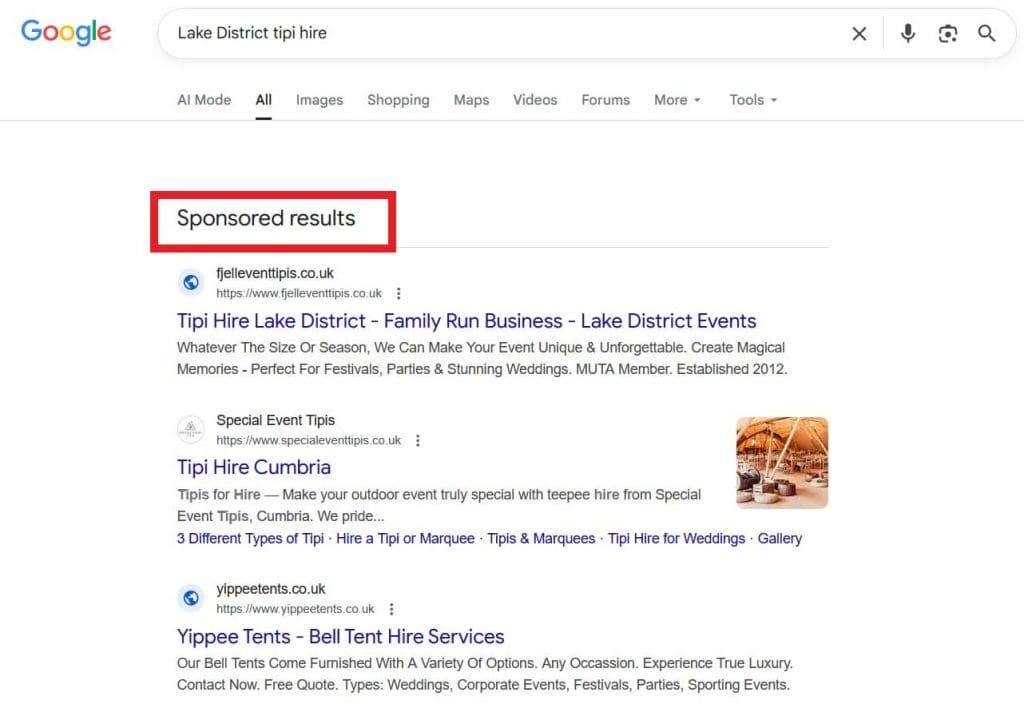
In general, Google Ads will show two or three ads above the organic results, then more at the bottom of the page, and sometimes even more in between the organic listings. By placing your own ad, you not only knock at least one of those competitors off a top spot, but you also double your own visibility. Now your target audience will see your site in both the ads and the organic listings. You’re taking up more space and are therefore more likely to be noticed.
Even if you’re not showing organically in the top results, PPC can give you a head start by allowing you to ‘skip the queue’ while you wait for your SEO strategy to take effect.
You can dominate the results even further by optimising your social media for SEO so that your social sites also appear in search.
Keyword Research
Both SEO and some types of PPC ads require effective keyword research to target relevant users who are looking for what you offer. By using both of these marketing tools, you can share keyword data to adjust and improve your strategy.
If you haven’t been working on SEO for long, you won’t have a huge amount of organic keyword data to analyse yet. However, as PPC campaigns provide much quicker results, you can use these keywords to inform your SEO.
After running ads for a short time, take a closer look at the search phrases that trigger them (find this information in Google Ads under Campaigns > Insights and reports > Search terms). Which ones are converting well? These can be used in your SEO to create copy that will also drive organic traffic to your website.
Similarly, once you start seeing results from your SEO work, keyword data (which can be found in Google Search Console) can be used to better target paid ads.
Creating Content
Copy (the text on your ads or website) that performs well in ads has a good chance of performing well in organic search too.
As we’ve already established, ads provide quick results, so you can use them to rapidly test different copy, analyse results, and identify the best performers. By using high-performing text from your ads in your SEO content, you can boost your chances of climbing the organic rankings. Use the ad text for page titles, content, and meta data.
You can organically test copy, too, but this will take longer.
Brand Awareness
The more a user sees your brand, the more likely they are to think of you when they’re ready to buy. Ensuring your business shows up in both ads and organic results means you gain more visibility, and you make users twice as aware of your brand. If you’re not yet ranking highly with SEO, then ads provide a good way to introduce your brand to new customers.
The better a user knows you, the more likely they are to trust you as a company, to click through to your site, and to ultimately make a purchase.
Shopping Ads
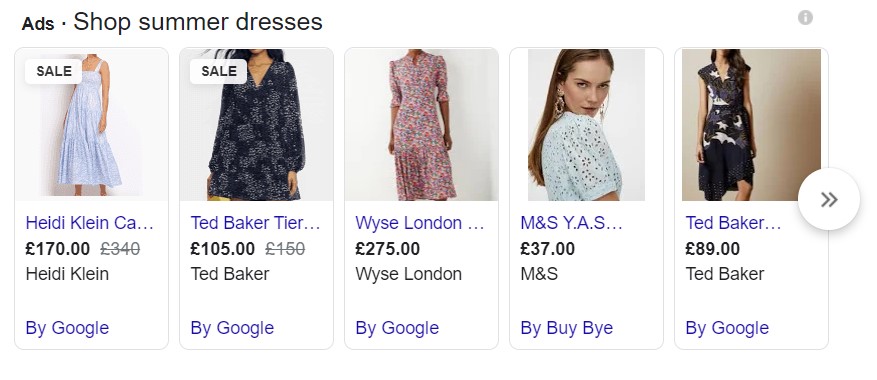
There are all sorts of different types of PPC ads, and some are directly influenced by SEO. Google’s Shopping Ads, for example, pull information directly from your website and use the information there to display your products to potential customers. By optimising product pages on your website, you also optimise your ads.
Site Search
It’s beneficial for SEO to include a search function on your website, particularly for larger sites. If users regularly utilise this, you can see exactly what they’re searching for on-site and use this information to influence your external PPC campaigns.
Users seeking specific products are probably actively considering buying, and you can serve ads related to popular site searches to target similar people.
User Demographics
Making use of speedy PPC again, you can test demographics with ads. Target ages, gender, household income and more with your ads and see who’s most interested in your site. Not only can you use this data to double-down on the most effective PPC ads, but it can influence the way you present content on your site. Does your writing style, overall site experience, and brand resonate with the people most likely to use it? Let this information inform your SEO strategy as necessary.
Conclusion
SEO and PPC can work well separately, especially if you don’t have the resources to implement both. However, as and when you’re able, I would recommend using both in order to boost visibility, increase sales, and generate more website traffic.